Publication and freshness
This article predates our verified-timestamp system; its original publication date was not reliably recorded, so no publication or freshness date is claimed.
Byline record
Editorial Desk byline. No personal contributor profile is claimed.
Sources and method
Inspect the primary-source links in the article and our research method. Changing rules must be rechecked at the official source.
Separate review record
No separately stored fact-checker or fact-check date is published for this article. Edit history: no recorded revisions since revision tracking began.
The Con Rit is Vietnam's famous sea-serpent legend, reportedly seen off Along Bay in 1883. We tell the cryptid story honestly, then guide you to the real coast — Ha Long, Lan Ha, Bai Tu Long and Cat Ba.
Somewhere off the limestone islands of northern Vietnam, sailors once swore they saw a creature longer than their boats — a segmented, armoured body rising and sinking through the jade-green water like a living train of carriages. They called it the Con Rit, and for more than a century it has drifted between ship's-log report, fishermen's warning, and full-blown legend.
The Con Rit is a cryptid: an animal that folklore and a handful of historical accounts insist is real, but that science has never confirmed. There is no specimen, no skeleton, no photograph that holds up. What there is — and what makes the story worth a traveller's attention — is the place itself. The waters where the Con Rit was supposedly seen are some of the most genuinely otherworldly seascapes on Earth: Ha Long Bay, Lan Ha Bay, Bai Tu Long and the karst-studded coast around Cat Ba Island.
This guide tells the legend honestly — as a legend — and then does the more useful thing: it shows you how to actually go and feel that "something-in-the-deep" atmosphere for yourself, on a real Vietnamese coast that needs no monster to be unforgettable.
Quick facts
| What it is | A legendary giant sea serpent / sea-monster (a cryptid) of Vietnamese coastal folklore |
| Name meaning | "Con rit" is commonly glossed as millipede or centipede in Vietnamese — a nod to its many-segmented look |
| Famous "sighting" | Reported off the Along Bay (Ha Long Bay) region of northern Vietnam, with a much-cited account dated to 1883 |
| Status | Unconfirmed — folklore and anecdote, not a recognised species |
| Where to experience the vibe | Ha Long Bay, Lan Ha Bay, Bai Tu Long Bay, Cat Ba Island (Quảng Ninh / Hải Phòng, northern Vietnam) |
| Gateway city | Hanoi (≈ 2.5–4 hours by road to the cruise ports) |
| Best season | Roughly October–April (cool, drier, clearer); avoid peak typhoon risk in late summer |
| Visa for Pakistanis | Vietnam runs an e-visa — check current eligibility and stay length on the official portal before booking |
The Con Rit legend — and the honest cryptozoology
Sea-serpent stories cling to almost every seafaring culture, and Vietnam's contribution is the Con Rit. In the cryptozoology literature it's usually described as an enormous elongated sea animal with a segmented or plated body — picture overlapping armoured rings rather than smooth scales — sometimes credited with fringing fins or "legs" running down each side, which is exactly why the centipede/millipede name stuck.
The most frequently repeated account places a Con Rit carcass or sighting in the Along Bay area (the old French spelling of Ha Long Bay) in 1883, a story later popularised in Western cryptozoology writing, including discussion associated with the naturalist Dr A. Krempf, who worked in Indochina in the early 20th century. As the tale goes, a long, hard-bodied creature was found or observed, measured at an improbable length, and then lost before any specimen could be properly preserved and studied.
Here's the honest part. None of this is verified. There is no surviving specimen, no peer-reviewed description, and no photographic evidence. Skeptics point out that decomposing whale sharks, basking sharks, oarfish, and "globsters" (shapeless masses of decaying marine tissue and whale blubber) have fooled observers worldwide and generated near-identical "sea monster" reports. A very long, segmented-looking shape in the water can be a line of dolphins, a string of salps, a piece of floating debris, or simply a story that grew with each retelling in the harbour.
So treat the Con Rit the way you'd treat the Loch Ness Monster or the Kraken: a wonderful piece of maritime folklore that says more about how humans read mystery into the sea than about marine biology. It is a legend, not a confirmed animal — and that's precisely what makes it a fun lens for a very real trip. For broader encyclopedic background on the cryptid itself, see Wikipedia's entry on Con rit.
Why go — the real "mystery of the deep"
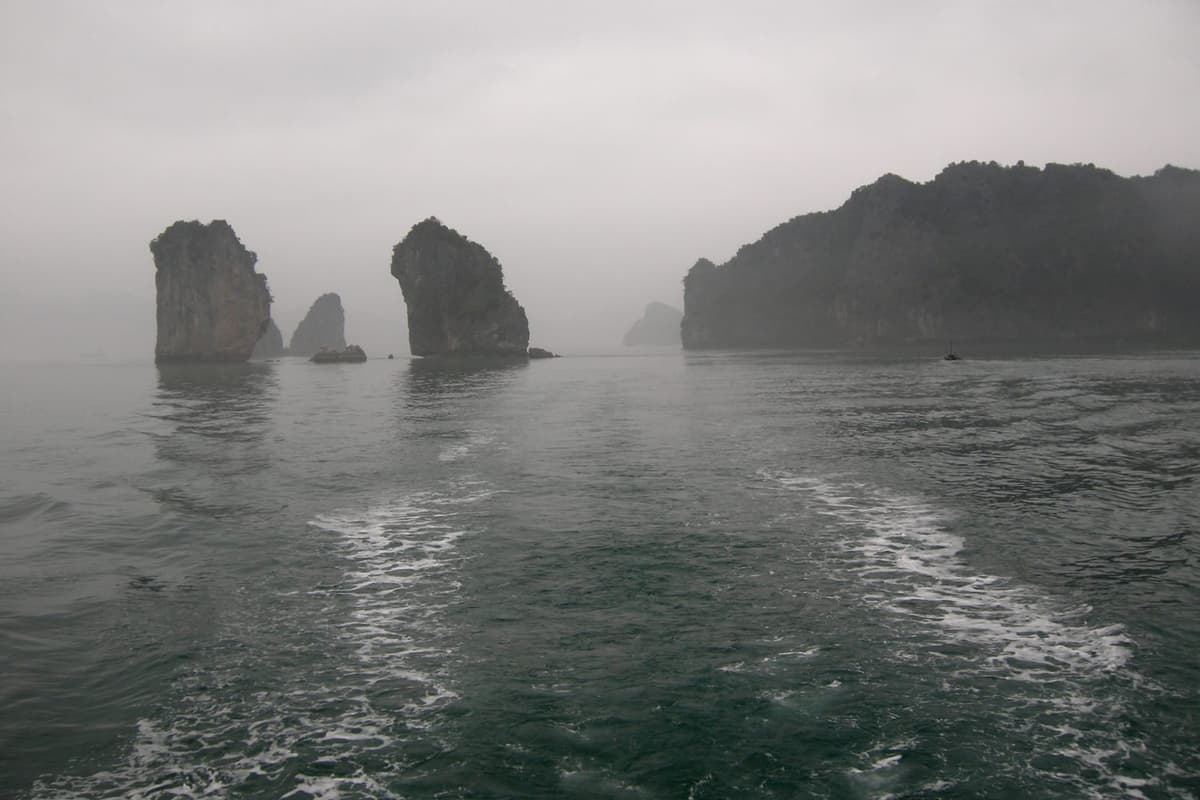
You don't need a monster to feel watched by the sea here. Northern Vietnam's bays are a drowned karst landscape: thousands of limestone pillars and islets, riddled with caves, hidden lagoons and tunnels you can only reach at the right tide. Mist sits between the towers at dawn; the water turns from emerald to slate when clouds roll in; and when your cruise engine cuts out for the night, the silence around those black silhouettes is genuinely eerie — in the best way.
That atmosphere is the honest payoff of the Con Rit story. If a sea serpent were going to live anywhere, your imagination tells you it would be here. Add kayaking into sea caves, swimming off the boat, a lantern-lit deck at night, and floating fishing villages that have worked these waters for generations, and the "mystery of the deep" feeling writes itself.
Best time to visit
Northern Vietnam has a distinct seasonal swing, so timing matters more than people expect.
- October to April — the sweet spot. Cooler, generally drier, and the clearer light makes the karst scenery pop. Late autumn and spring are popular for good reason.
- May to September — hot, humid, and the typhoon window. Summer brings the best chance of warm swimming but also heat, haze and the risk of storms that can cancel cruises for safety. Operators do suspend sailings in bad weather — build a buffer day into your plans.
- Winter (Dec–Feb) can be cool and occasionally grey on the water; pack a layer for evenings on deck.
Because conditions change year to year, check a current marine/weather forecast and your operator's cancellation policy before locking in dates. For the wider question of "where's good when," our month-by-month weather guide is a useful planning companion.
How to get there
Step one: fly to Hanoi. Hanoi (Noi Bai International Airport, HAN) is the gateway for the whole northern bay region. From Pakistan there's no direct flight, so expect a one- or two-stop routing — commonly via a Gulf or Southeast Asian hub — from Karachi, Lahore or Islamabad. Compare routings and fares on flights and watch for the cheaper shoulder-season fares.
Step two: Hanoi to the bays. The main jumping-off ports are around Ha Long City / Tuần Châu (for Ha Long and Bai Tu Long Bay) and Hai Phong / Got Pier (for Lan Ha Bay and Cat Ba Island).
- Cruise transfer (easiest): most multi-day cruises include a shuttle bus from Hanoi's Old Quarter to the pier and back — roughly 2.5–4 hours each way depending on the port and traffic. This is the simplest option and what most first-timers choose.
- Expressway by car/bus: the modern Hanoi–Ha Long expressway has cut travel times sharply; private cars and limousine vans run frequently.
- Cat Ba route: reaching Cat Ba Island involves a road-and-ferry combination via Hai Phong; many travellers book a through-ticket that bundles bus and boat.
If you'd rather not stitch transfers together yourself, build the whole chain in our trip planner or look at bundled holiday packages.
What to see and do
Ha Long Bay
The headline act and a UNESCO World Heritage Site, Ha Long ("descending dragon") Bay is the postcard Vietnam: thousands of limestone islands rising from emerald water. Overnight cruises are the classic way to experience it — sailing past the famous rock formations, visiting show caves, and waking up among the karsts. For the official heritage description, see UNESCO's Ha Long Bay listing.
Lan Ha Bay
Just south of Ha Long and far less crowded, Lan Ha Bay offers the same drowned-mountain scenery with more swimming beaches and quieter anchorages. It's a favourite for kayaking and for travellers who want the magic without the busiest channels.
Bai Tu Long Bay
North-east of Ha Long, Bai Tu Long is wilder and greener, with fewer boats and a stronger sense of remoteness — ideal if you want that hush-on-the-water, "anything-could-be-down-there" feeling the Con Rit legend trades on.
Cat Ba Island
The largest island in the area, Cat Ba anchors a national park, jungle trekking, climbing and bays full of monkeys and birdlife. It's the natural base for exploring Lan Ha Bay and a good budget-friendlier alternative to a pricey live-aboard.
The things you actually remember
- Kayaking into sea caves and through low rock arches into hidden lagoons.
- Caves — lit show-caves like the big grottoes, plus smaller tide-gated tunnels.
- Floating fishing villages and pearl farms, where families live and work on the water.
- Swimming and cliff-side beaches straight off the boat.
- Squid fishing and a lantern-lit night on deck — the most atmospheric way to channel a sea-monster mood without leaving your cruise.
Want the legend elsewhere on the map?
If you're collecting Earth's strange, deep, dramatic places, pair this with our roundup of the planet's most incredible cave waterfalls — another set of landscapes that feel built for myth.
Costs and booking notes
Prices swing hugely with season, boat class and how far ahead you book, so treat these as planning ranges, not quotes — confirm the live price with the operator.
- Day cruise: the cheapest taster, often a few tens of US dollars per person.
- Overnight (1 night / 2 days) cruise: the most popular format; mid-range cabins commonly land in the low-to-mid hundreds of US dollars per person, rising steeply for luxury vessels.
- 2 nights / 3 days: more time, more of the quieter bays, proportionally higher cost.
- Cat Ba budget route: independent travel via Cat Ba (hostel/hotel + day boat) is the lightest on the wallet.
What to check before paying: whether entrance/cruising fees, meals, kayaking and transfers are included; the cancellation and bad-weather policy (important in storm season); and the boat's real size and age (photos can flatter). Pay by a method that gives you recourse, and keep the operator's licence/registration details.
For Pakistani travellers, also budget for flights (compare on flights), the e-visa fee, and travel cover — sensible given that cruises can be weather-disrupted. Look at travel insurance before you go.
Visa and entry notes for Pakistani travellers
Vietnam operates an electronic visa (e-visa) applied for online before travel — you upload a photo and passport scan, pay the fee, and receive an approved e-visa to print and present on arrival. In recent years Vietnam has expanded e-visa access significantly, but eligibility lists, validity (single vs multiple entry) and the maximum stay are exactly the kind of rules that change.
Do not rely on this article for the current rule. Before booking anything, confirm whether your passport is currently eligible, the fee, and the permitted stay on the official Vietnam e-visa portal (evisa.gov.vn). Apply well ahead of your travel date and double-check that the name and passport number on the e-visa exactly match your passport.
Need a hand with the paperwork? Our visa services page can point you in the right direction for a Vietnam application.
Safety and practical tips
- Weather is the real risk, not monsters. Cruises can be delayed or cancelled in storms — that's a safety feature, not a scam. Keep your itinerary flexible around the bay portion.
- Check the boat's safety standards. Life jackets, fire equipment and a sober, licensed crew matter. Reputable operators are upfront about this.
- Mind the tides and currents when kayaking or swimming; go where the crew directs and don't paddle off alone into caves on an outgoing tide.
- Money: the Vietnamese đồng (VND) is cash-friendly; carry some cash for villages, tips and small vendors, even though cards work in cities and on bigger boats.
- Health: bring motion-sickness tablets if you're prone to seasickness, sun protection, and any personal medication — pharmacies are limited at sea.
- Respect local life: the floating villages are people's homes and workplaces, not a theme park — ask before photographing.
Itinerary ideas
- Long weekend (3–4 days): Hanoi Old Quarter (1 night) → overnight Lan Ha or Ha Long cruise (1 night) → back to Hanoi. The efficient first-timer loop.
- One week: Hanoi → 2-night Bai Tu Long or Lan Ha cruise → a couple of nights on Cat Ba Island for hiking and quieter bays → optional add-on to Ninh Binh's inland karsts ("Ha Long on land").
- Slow and atmospheric: base on Cat Ba, do day trips by kayak and small boat into Lan Ha's hidden lagoons, and chase the misty mornings that make these waters feel haunted in the loveliest sense.
For more places to file under "landscapes that feel like legends," browse our wider destination guides.
FAQ
Is the Con Rit real?
No — not as a confirmed species. The Con Rit is a cryptid: a creature of folklore and a few unverified historical accounts, with no specimen, skeleton or solid photographic evidence. Most reported "sea serpents" worldwide turn out to be decaying marine animals, oarfish, or simply misread shapes in the water. Enjoy it as a legend.
Where was the Con Rit supposedly seen?
The best-known account is tied to the Along Bay (Ha Long Bay) region of northern Vietnam, with a much-repeated date of 1883. That's the same stretch of karst coast — Ha Long, Lan Ha, Bai Tu Long — that draws travellers today.
When is the best time to cruise Ha Long and Lan Ha Bay?
Broadly October to April for cooler, clearer, drier conditions. Late summer is hot and carries typhoon risk that can cancel sailings, so check the forecast and your operator's weather policy before booking.
How do I get from Hanoi to the bays?
Fly into Hanoi (HAN), then transfer by road (and ferry, for Cat Ba) to the cruise ports — usually 2.5–4 hours. Most multi-day cruises include the Hanoi shuttle. Compare flights to Hanoi on our flights page.
Do Pakistani travellers need a visa for Vietnam?
Yes — Vietnam requires a visa, and most visitors now use the online e-visa. Eligibility and stay length change, so verify your status on the official evisa.gov.vn portal and see our visa services for help applying.
Is a Ha Long Bay cruise safe?
Generally yes with a reputable operator. The main variable is weather — storms can delay or cancel cruises for safety. Choose a licensed boat with proper safety gear, follow the crew's guidance on swimming and kayaking, and keep your plans flexible.
Conclusion
The Con Rit will almost certainly never be caught, photographed, or filed in a museum drawer — and that's fine. Its real gift is the way it points you toward one of the most atmospheric coastlines on the planet, where limestone giants stand in the mist and the water guards its secrets. Go for the legend if you like; you'll stay for the kayaking at dawn, the caves no map quite captures, and the long, quiet night on deck when the bay goes still and your imagination does the rest. Sort the flights and the e-visa early, time it for the dry season, and let northern Vietnam supply the mystery — no monster required.
Written by
Travel.pk Editorial Desk
Researches and edits practical travel guidance for people planning journeys from Pakistan.
How we research and edit →Comments
Loading comments…