Publication and freshness
This article predates our verified-timestamp system; its original publication date was not reliably recorded, so no publication or freshness date is claimed.
Byline record
Editorial Desk byline. No personal contributor profile is claimed.
Sources and method
Inspect the primary-source links in the article and our research method. Changing rules must be rechecked at the official source.
Separate review record
No separately stored fact-checker or fact-check date is published for this article. Edit history: no recorded revisions since revision tracking began.
A traveller's guide to the world's most incredible cave and underground waterfalls that are open, legal and safe to visit, from Ruby Falls to Jeita Grotto, with tours, timing and tips.
There is something almost mythical about a waterfall you cannot see from the surface. Somewhere below your feet, in a limestone chamber carved over hundreds of thousands of years, water is falling through total darkness — and a handful of these underground cascades have been made safe enough for ordinary travellers to walk right up to them.
This is a guide to the most incredible cave and underground waterfalls in the world that you can actually visit legally, on a ticket, with a guide and a handrail. We have deliberately left out the famous-but-deadly wild caves that require ropes and permits. Every site below runs commercial tours, is currently open, and welcomes families.
Most of these are long-haul trips from Pakistan, so we have framed each one with how to get there, when to go, and what it realistically costs, plus a planning section and cave-safety basics at the end.
Quick facts
| Detail | Summary |
|---|---|
| What | Cave / underground / subterranean waterfalls open to the public |
| Sites covered | 9 across the USA, New Zealand, Lebanon, Slovenia, Japan, Thailand and the UK |
| Tallest publicly accessible underground waterfall | Ruby Falls, Tennessee — 145 ft (44 m) |
| Typical tour length | 60–120 minutes, guided, on lit and paved or boardwalk paths |
| Typical entry cost | Roughly USD 15–40 / PKR equivalent per adult, depending on country |
| Best for | Families, photographers, geology lovers, rainy-day or hot-season trips |
| Difficulty | Mostly easy; expect stairs, cool damp air (10–17°C) and some uneven sections |
Why visit a cave waterfall
A cave waterfall combines two of nature's most dramatic features in one cool, weatherproof package. The temperature underground stays roughly constant year-round, so these make brilliant escapes from a brutal summer or a wet day. They are also unusually accessible: because the sites are commercial, you generally get lit paths, boardwalks or boats, and a guide who keeps you safe and explains the geology.
For travellers planning a wider itinerary, cave waterfalls are easy to slot in. Most sit within a day trip of a major city or another headline attraction, so you rarely build a whole holiday around them — you fold them into one you are already taking. Use our destination guides and the trip planner to see how a cave stop fits a longer route.
The most incredible cave waterfalls you can visit
Ruby Falls, Tennessee, USA
Why visit: At 145 feet (44 m), Ruby Falls is widely described as the tallest and deepest underground waterfall open to the public in the United States, and one of the tallest publicly accessible underground waterfalls anywhere. You descend more than 1,100 feet inside Lookout Mountain in a glass-front elevator, then walk a paved cavern trail to a thundering, dramatically lit cascade.
Location: Lookout Mountain, on the edge of Chattanooga, Tennessee.
How to visit: Buy a guided tour ticket — the standard Classic Waterfall walk, or specialty Lantern and extended-cavern experiences — from the official Ruby Falls site. Tours sell out, so book online ahead.
Best time: Open year-round; the cave is climate-stable, so a hot or rainy day is ideal. Mornings are quieter.
Access & safety note: The standard route is paved and guided. As of 2026 it is open and operating; confirm hours and any specialty-tour age limits before you go.
Cathedral Caverns State Park, Alabama, USA
Why visit: Cathedral Caverns is famous for its enormous formations and its "Frozen Waterfall" — a vast flowstone roughly 32 feet tall and 135 feet wide, one of the largest of its kind. The park even pumps water to recreate the look of the falls that once carved it.
Location: Woodville, northern Alabama, within driving distance of Huntsville.
How to visit: A state park with guided cave tours; book through the Alabama State Parks system.
Best time: Year-round; the cave stays cool, so it is a great hot-day stop.
Access & safety note: The main walkway is wide and well maintained — one of the more accessible cave tours in the region. Be honest with yourself about the entrance slope and check current accessibility details when booking.
Natural Bridge Caverns, Texas, USA
Why visit: Texas's largest commercial cavern system runs deep beneath a 60-foot natural limestone bridge, with huge active chambers like the Hall of the Mountain King. It is a living cave — water still drips and pools — and tours pass flowing and standing water features alongside spectacular formations.
Location: About 30 minutes north of San Antonio.
How to visit: Several guided tours (the Discovery Tour is the classic) plus above-ground activities; tickets via Natural Bridge Caverns.
Best time: Year-round; pairs well with a San Antonio or Texas Hill Country trip.
Access & safety note: Expect stairs and humidity. The Discovery Tour is the most accessible; adventure tours are physically demanding and not for everyone.
Ruakuri Cave, Waitomo, New Zealand
Why visit: Ruakuri is New Zealand's longest guided underground walking tour, and the soundtrack is the thunder of subterranean waterfalls echoing through limestone chambers — all under a ceiling of glowworms. You enter down a dramatic man-made spiral and wind past crystal tapestries and rushing water.
Location: Waitomo, in the Waikato region of the North Island.
How to visit: Book the 1.5-hour guided tour through Discover Waitomo. It is designed to be inclusive and is wheelchair- and pushchair-accessible (within stated width limits).
Best time: Year-round; New Zealand's summer (December–February) is peak season, so book early then.
Access & safety note: One of the more accessible cave experiences anywhere, but it is still a long way underground — wear sturdy shoes and a layer for the cool, damp air.
Jeita Grotto, Lebanon
Why visit: Jeita is a two-level limestone wonder near Beirut where an underground river runs through galleries of immense stalactites. The lower cave is explored by electric boat when water levels allow, and the system is fed by flowing water and cascades — a genuine subterranean river experience and a national landmark.
Location: Nahr al-Kalb valley, about 18 km north of Beirut.
How to visit: Guided visits include the upper galleries on foot and a boat ride in the lower cave when conditions permit, often with a cable car or train on site. Note that photography is not allowed inside the grottos. See Lebanon's tourism information and book ahead in busy periods.
Best time: Summer for the boat (water levels permitting); the lower cave can close when the river is high.
Access & safety note: Jeita reopened in mid-2025 after a temporary closure for upgrades, so it is open in 2026 — but the lower boat section depends on water levels and may be shut in winter. Confirm both cave levels are running before you travel. Pakistani travellers should also check current Lebanon visa rules and any travel advisories well in advance; see our visa services and arrange travel insurance.
Škocjan Caves, Slovenia
Why visit: A UNESCO World Heritage Site and one of Europe's great underground canyons. The Reka River vanishes underground here and carves waterfalls, rapids and a colossal chamber — and you cross it on the Cerkvenik Bridge suspended around 50 metres above the roaring river. It is, by common consent, one of the most jaw-dropping subterranean experiences in Europe.
Location: Slovenian Karst, about 80 km from Ljubljana.
How to visit: The caves are seen only on a guided tour (around 1.5 hours, with roughly 3 km of walking and hundreds of steps). Book through the official park.
Best time: Spring through autumn for the fullest tour schedule; the cave holds around 12°C, so bring a layer even in summer.
Access & safety note: This is a more demanding tour — many steps and uneven ground, not suitable for those with limited mobility (though shorter exit options and disabled access provisions exist; arrange these in advance).
Akiyoshido Cave, Japan
Why visit: Japan's largest limestone cave, with a 1 km lit tour route that passes underground waterfalls and the spectacular "Hyakumai-zara" (Hundred Plates) — terraced rimstone pools stacked like dishes. The cave holds a steady ~17°C all year, making it a cool retreat in summer and a mild one in winter.
Location: Mine, Yamaguchi Prefecture, on Honshu.
How to visit: Self-guided along the lit main route (about an hour) with a modest entry fee (around ¥1,200); an elevator links up to the Akiyoshidai plateau. See Japan tourism information. Photography is generally allowed.
Best time: Year-round; lovely in the heat of a Japanese summer.
Access & safety note: Well-maintained walkways suit most ages, but there are damp, uneven sections — sensible footwear matters.
Tham Lod Cave, Thailand
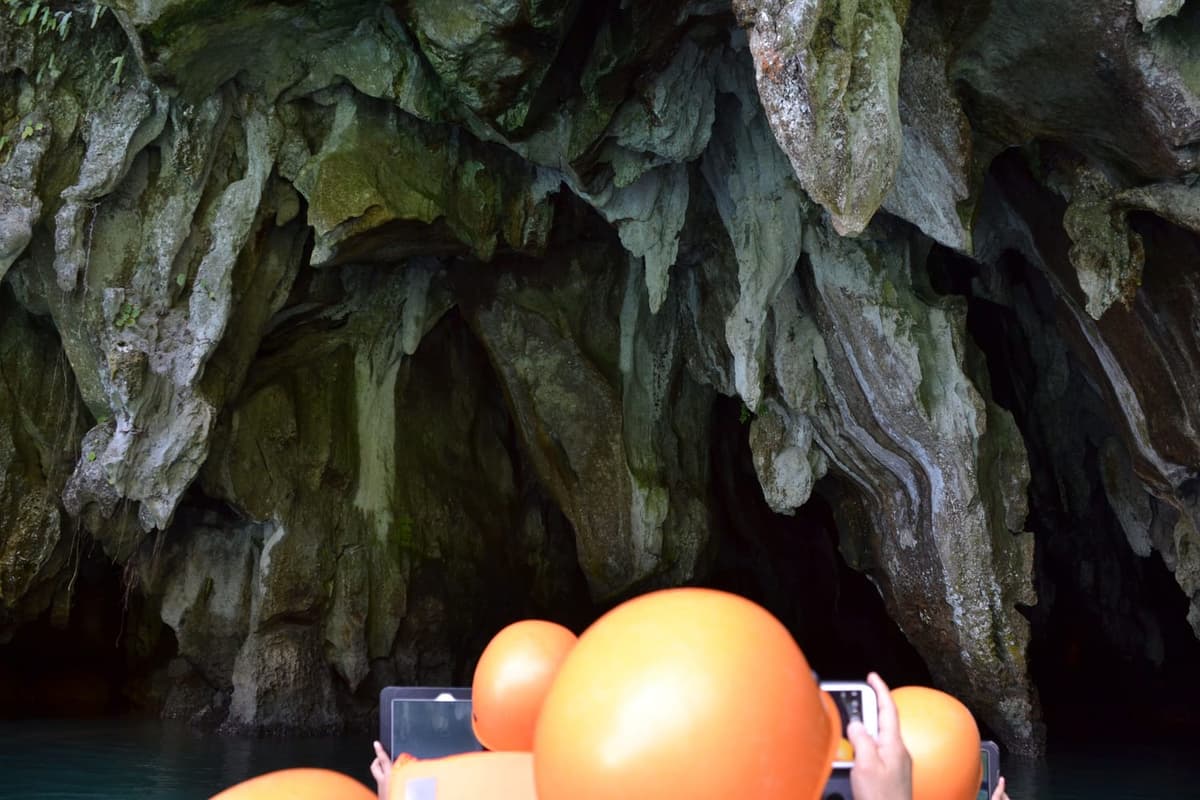
Why visit: A spectacular river cave near Pai where the Lang River flows straight through the mountain. You explore by bamboo raft with a local guide and a gas lantern, drifting beneath 50-metre-high chambers, past stalactite formations and rushing water — a rawer, more adventurous cave-and-water experience than the boardwalk caverns above.
Location: Mae Hong Son province, northern Thailand, near Soppong/Pai.
How to visit: Hire a local guide and raft on site (lantern and raft fees are modest); typically open roughly 8am–5pm. See travel information for the area. At dusk, vast clouds of bats and swifts swirl out of the cave.
Best time: Drier months (roughly November–February). In heavy rain the river can rise and rafting may be limited.
Access & safety note: This is genuinely outdoorsy — wet feet, basic rafts, lantern light. It is safe with a guide, but not a polished, accessible cavern; skip the raft section if the water is high.
Marble Arch Caves, Northern Ireland
Why visit: The most active river cave in Ireland and the UK, where three underground rivers carved a system of chambers and waterfalls. Part of the tour even runs on the water — you travel a short stretch by underground boat alongside spectacular stalactites, within a UNESCO Global Geopark.
Location: Near Enniskillen, County Fermanagh, Northern Ireland.
How to visit: Guided tours (around 75 minutes) from the visitor centre; book via the official caves site. Because it is an active river cave, tours can be suspended after heavy rain when water levels rise.
Best time: Late spring to early autumn, when the cave is most reliably open; always check the daily status before travelling.
Access & safety note: The boat section and water levels make this weather-dependent — call or check online the same day. Sturdy shoes and a jacket recommended.
How to plan a caves-and-waterfalls trip
You almost never fly across the world for a single cave. The trick is to anchor each cave to a bigger destination you are already visiting:
- USA cluster: Ruby Falls (Chattanooga) and Cathedral Caverns (near Huntsville) are an easy regional pairing; Natural Bridge Caverns fits a Texas trip around San Antonio.
- Asia-Pacific: Ruakuri sits inside any North Island New Zealand route; Akiyoshido fits a western-Japan loop; Tham Lod pairs naturally with Pai and Chiang Mai in northern Thailand.
- Europe/Middle East: Škocjan is a day trip from Ljubljana (and pairs with Postojna Cave and Predjama Castle); Marble Arch suits a Northern Ireland road trip; Jeita is a half-day from Beirut.
For Pakistani travellers, the practical starting point is the long-haul flight. Search routings from Karachi, Lahore or Islamabad to the nearest hub — for example into the US East Coast for Tennessee/Alabama, into Auckland for New Zealand, into Tokyo or Osaka for Japan, into Bangkok then Chiang Mai for Thailand, into Beirut for Lebanon, or into Ljubljana/Trieste or Dublin for the European caves. Compare fares on flight search, then sort visas via our visa services and protect the trip with travel insurance. If you would rather have it all arranged, our trip planner and holiday packages can bundle flights, stays and day tours.
A simple rule of thumb: book the cave tour before you book the day, because the popular sites (Ruby Falls, Ruakuri, Škocjan) sell out, and the river caves (Marble Arch, Jeita's boat, Tham Lod) can close at short notice when water is high.
Cave-safety tips for first-time visitors
Commercial cave tours are safe, but the underground has its own etiquette:
- Dress for 10–17°C and damp. Even on a hot day, bring a light jacket and wear closed shoes with grip — surfaces are wet.
- Mind the steps and stay on the path. Many caves involve stairs and uneven floors; handrails are there for a reason, and stepping off-path damages formations and risks a fall.
- Don't touch the formations. Skin oils stop stalactites growing; several caves (like Jeita) enforce strict no-touch and no-photo rules.
- Respect water-level closures. River caves can shut without much notice after rain — never try to "wait it out" or go off-route.
- Check accessibility honestly. Some tours (Ruakuri, Cathedral Caverns) are genuinely accessible; others (Škocjan, the adventure tours) involve hundreds of steps. Ask before you book if mobility is a concern.
- Carry less, not more. Bulky bags and tripods are often restricted; check each site's rules.
Nearby and itinerary ideas
If underground wonders are your thing, you will also enjoy above-ground natural drama. Pair a cave-waterfall trip with our guide to the best archaeological sites in the world for a history-plus-nature route, and use the holiday weather guide: best places by month to time long-haul trips around the dry seasons that keep river caves open. A Slovenia cave day, for instance, slots neatly into a wider Central-Europe summer; a New Zealand cave belongs in a longer South Pacific itinerary.
FAQ
What is the tallest underground waterfall you can visit?
Ruby Falls in Tennessee, at 145 feet (44 m), is widely cited as the tallest and deepest underground waterfall open to the public in the United States, and one of the tallest publicly accessible underground waterfalls anywhere in the world.
Are cave waterfall tours safe for children and older travellers?
Most are. Sites like Ruakuri (New Zealand) and Cathedral Caverns (Alabama) are designed to be accessible, with smooth paths and gentle gradients. Others — Škocjan in Slovenia and adventure tours generally — involve hundreds of steps and are better for fit visitors. Always check each site's accessibility details when booking.
Do I need a guide, or can I explore on my own?
It varies. Ruby Falls, Ruakuri, Škocjan, Marble Arch and Jeita are guided-tour only. Akiyoshido in Japan is largely self-guided along a lit route. Tham Lod in Thailand uses a local rafter-guide. Never enter a wild cave alone — this guide only covers managed, ticketed sites.
When is the best time of year to visit a cave waterfall?
Underground temperatures stay roughly constant, so the cave itself is fine year-round — but river caves depend on the weather. Go in the drier months for Tham Lod (roughly November–February), check daily status for Marble Arch and Jeita's boat section, and book ahead in summer peaks for Ruby Falls, Ruakuri and Škocjan.
Can I take photos inside?
Depends on the site. Akiyoshido generally allows photography; Ruby Falls and many US caves permit it. Jeita Grotto bans photos and videos inside the grottos. Always check and respect each cave's rules — and never use flash where it is prohibited.
How much do cave waterfall tours cost?
Roughly USD 15–40 (or the local equivalent) per adult for the headline sites, with river-cave raft fees in Thailand far lower. Prices change, so confirm the current rate on each official site linked above before you travel; we have avoided quoting exact figures that may be out of date.
Conclusion
Cave waterfalls are one of travel's best-kept secrets: dramatic, weatherproof, family-friendly and almost always cheaper than the headline attractions nearby. From Ruby Falls deep under Tennessee to the boat ride through Jeita's underground river and the roaring canyon of Škocjan, each one rewards a short detour with a memory that the surface simply can't match.
Pick the one that fits a trip you are already planning, book the tour early, dress for the cool damp, and let a guide lead you into the dark. When you are ready, start with flight search and the trip planner to build the route around it.
Written by
Travel.pk Editorial Desk
Researches and edits practical travel guidance for people planning journeys from Pakistan.
How we research and edit →Comments
Loading comments…