Publication and freshness
This article predates our verified-timestamp system; its original publication date was not reliably recorded, so no publication or freshness date is claimed.
Byline record
Editorial Desk byline. No personal contributor profile is claimed.
Sources and method
Inspect the primary-source links in the article and our research method. Changing rules must be rechecked at the official source.
Separate review record
No separately stored fact-checker or fact-check date is published for this article. Edit history: no recorded revisions since revision tracking began.
A practical guide to Sherwood Forest, legendary home of Robin Hood — the Major Oak, the RSPB visitor centre and trails, Edwinstowe, the Robin Hood Festival, nearby Nottingham, and how to get there.
For eight hundred years, one English forest has belonged to an outlaw who may never have existed. Sherwood Forest, in Nottinghamshire in the English Midlands, is where the legend of Robin Hood took root — the green-clad archer who robbed the rich, fed the poor, romanced Maid Marian and outwitted the Sheriff of Nottingham from a hideout deep among the oaks. Whether he was real, a composite of medieval ballad heroes, or pure folklore, the forest he made famous is very much here, and you can walk it.
Today Sherwood is a National Nature Reserve: a surviving fragment of the great royal hunting forest that once covered much of the county, now a patchwork of ancient oaks, silver birch and heathland threaded with easy trails. At its heart stood the Major Oak, the colossal thousand-year-old tree said to have sheltered Robin and his Merry Men — a tree that, after roughly a millennium, was declared dead in June 2026 but still stands as a monument.
This guide covers the legend and why it matters, the Major Oak and the visitor centre, the village of Edwinstowe and its church, the annual Robin Hood Festival, nearby Nottingham, how to get there, the best time to visit, and a short Robin Hood country itinerary — plus a note for travellers flying in from Pakistan.
Quick facts
| What | Ancient forest & National Nature Reserve — legendary home of Robin Hood |
| Where | Near Edwinstowe, Nottinghamshire, England; ~20 miles (32 km) north of Nottingham |
| Run by | The RSPB, on behalf of Nottinghamshire County Council |
| Star sight | The Major Oak — a ~1,000-year-old tree, now a standing monument (declared dead June 2026) |
| Entry to forest | Free; car parking is chargeable at the visitor centre |
| Visitor centre | Opened 2018, on the B6034 just north of Edwinstowe |
| Don't miss | Robin Hood Festival — an annual medieval event, held in August |
| Time needed | Half a day for the forest; a full day with Edwinstowe and a nearby town |
| Best time | Late spring to early autumn; bluebells in May, the festival in August |
Opening hours, parking charges and event dates change. Confirm the latest on the official Visit Sherwood and RSPB pages before you travel.
The legend, and why the forest is famous
Robin Hood first appears in English ballads in the 14th and 15th centuries, already a fully formed folk hero: an outlaw archer of extraordinary skill, leader of a band of "Merry Men," sworn enemy of corrupt authority. Over the centuries the stories accumulated the cast we know today — Little John, Friar Tuck, Will Scarlet, Maid Marian — and fixed themselves firmly to Sherwood Forest and the city of Nottingham, where the Sheriff held sway.
Historians have never found a single, certain Robin Hood. What they have found is a forest that was, in the medieval period, a genuine royal hunting preserve governed by harsh "forest law," where poaching the king's deer really could make you an outlaw. That kernel of truth — vast woodland, a powerful sheriff, ordinary people pushed outside the law — is what the legend grew around. For visitors, the appeal is simple: this is the place the story claims as home, and the forest is real, ancient and beautiful in its own right.
The Major Oak
The undisputed icon of Sherwood is the Major Oak, an enormous English oak that for centuries has been pointed out as Robin Hood's hideout. It is genuinely vast — a canopy spreading some 28 metres (92 feet) and a trunk circumference of around 11 metres (36 feet), which long made it one of the largest oak trees in Britain. It took its name not from any military major but from Major Hayman Rooke, an antiquarian who described it in a 1790 book on local oaks.
The tree is thought to have been around a thousand years old — far too young, strictly speaking, to have hidden a 13th-century outlaw, but old enough to have stood through most of English history since. For generations it survived with the help of props, chains and braces installed by well-meaning Victorians and their successors.
In June 2026 the RSPB announced that the Major Oak is believed to have died, after it failed to come into leaf that spring. The charity points to a combination of causes: more than a century of "preservation" that interfered with natural ageing, soil compacted hard by millions of visiting feet over the decades, and the added stress of recent hot, dry summers. Crucially, the RSPB has said the tree will remain standing for many years as a natural monument and a valuable habitat of decaying wood for insects, fungi and birds. You can still walk the boardwalk to see it; read the latest from the RSPB's update on the Major Oak before you go. It remains a moving thing to stand beside — a living link to the legend, and now a quiet lesson in how even giants reach an end.
The visitor centre, trails and Edwinstowe
The modern Sherwood Forest Visitor Centre, opened in 2018 and run by the RSPB, is the natural starting point. It sits on the B6034 just north of the village of Edwinstowe, with a café, shop, toilets, exhibitions on the forest and the legend, and the main (paid) car park. From here, way-marked trails fan out into the reserve.
- The Major Oak trail is the classic short walk — a gentle, largely accessible loop of roughly a mile (about 1.5 km) out to the famous tree and back.
- Longer waymarked routes push deeper into the ancient woodland and onto the heath, good for an hour or two of quiet walking among veteran oaks.
- The forest is a working National Nature Reserve, rich in wildlife: woodpeckers, nuthatches, fungi in autumn and a haze of bluebells in spring.
In Edwinstowe itself, a five-minute walk from the forest, stands the medieval Church of St Mary, parts of which date to around 1175. By tradition — legend rather than record — this is where Robin Hood and Maid Marian were married, and the village leans warmly into its Robin Hood heritage with a statue of the couple nearby. The church is a genuinely old and atmospheric building well worth the short detour; see Visit Nottinghamshire's listing for visiting details.
The Robin Hood Festival
If you can time your trip to it, the Robin Hood Festival is the highlight of the Sherwood calendar — a long-running medieval-themed event held at the forest in August, with a milestone 40th edition in 2026. Expect jousting knights, archery, combat displays, costumed characters, storytelling, music, craft stalls and plenty for children. Entry to the festival is typically free, though car parking is charged, and it draws big crowds, so arrive early or come by bus.
Exact dates and the daily programme are published each year, so check the official Robin Hood Festival 2026 page before planning around it. Even outside the festival, the forest runs family events and seasonal activities through the year.
Nottingham: castle, caves and the Sheriff's city
No Robin Hood trip is complete without Nottingham, the lively university city about 20 miles south of the forest and the legendary seat of the villainous Sheriff.
- Nottingham Castle — extensively redeveloped and reopened in recent years — sits on a sandstone rock above the city with museum galleries, the castle caves and grounds, and a bronze Robin Hood statue at its foot that is one of England's most photographed. Recent pricing has been around £18 per adult as a "visit all year" ticket (children 15 and under free, up to three per paying adult), with an optional cave tour around £9 on top. Confirm current prices and hours on the official Nottingham Castle site.
- The City of Caves is a separate, atmospheric network of man-made sandstone caves beneath the city centre, used over the centuries as tannery, cellars and air-raid shelters. Tours are guided and timed, and advance booking is wise; see the City of Caves site.
Nottingham makes an easy base, with hotels, restaurants and good transport links out to the forest.
Best time to visit
Sherwood is open year-round and each season has its draw:
- Late spring (April–May) brings fresh leaf and, in May, drifts of bluebells through the woodland — arguably the prettiest time.
- Summer (June–August) has the longest days, the best weather, and the Robin Hood Festival in August; it is also the busiest, so come early.
- Autumn (September–October) is wonderful for colour and fungi, with thinner crowds.
- Winter is bare and quiet but can be starkly beautiful; check that the café and centre hours suit you.
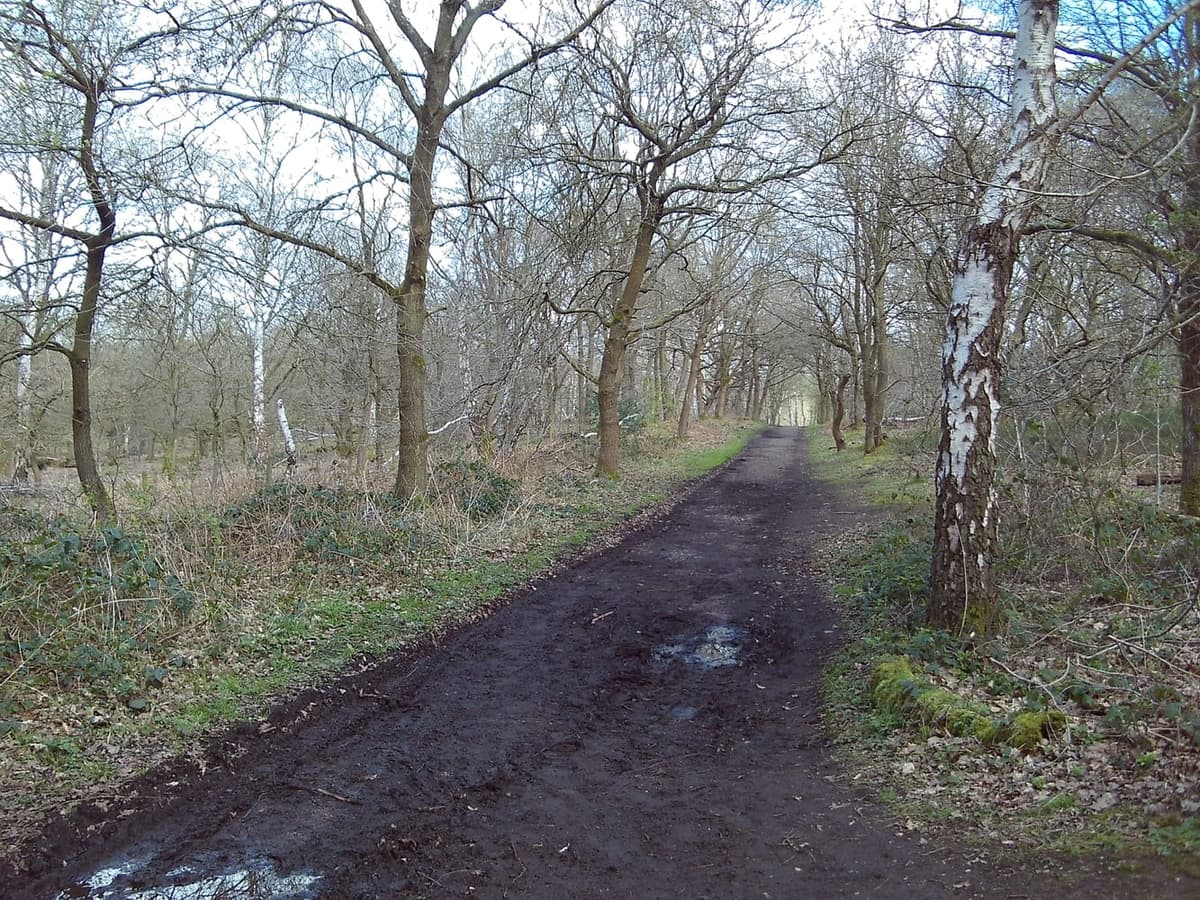
Whenever you come, wear sturdy footwear and bring a waterproof — this is the English Midlands, and the trails can be muddy after rain.
How to get there
Sherwood Forest is near Edwinstowe, off the B6034, roughly 20 miles (32 km) north of Nottingham and a similar distance from the larger towns of Mansfield and Worksop.
By car. The simplest option. From Nottingham it's about 40–50 minutes via the A60/A614; follow brown tourist signs to the visitor centre, where there is a chargeable car park.
By bus. The forest is well served and reachable car-free:
- From Nottingham, the Sherwood Arrow (Stagecoach) runs from the city out to Sherwood Forest, stopping near the visitor centre; the journey takes around an hour. Details on the Sherwood Arrow page.
- From Mansfield, local buses serve Edwinstowe, a short signed walk from the forest entrance. Services are reduced on Sundays and bank holidays, so check times before you set off.
By train, then bus. There is no station at the forest itself. Take a train to Nottingham or Mansfield and connect by bus. Nottingham is well connected to the national rail network — direct East Midlands Railway services from London St Pancras take roughly 1 hour 35 minutes to 1 hour 50 minutes, and there are direct or one-change services from Manchester, Birmingham, Sheffield and beyond. Check times and fares on National Rail.
What to do — walking, cycling and families
- Walking is the main event: the gentle Major Oak loop for a quick visit, or longer waymarked trails for a half-day among the ancient oaks.
- Cycling is possible on parts of the wider forest and nearby trails — handy for covering more ground and linking to neighbouring country parks; check the visitor centre for current routes and any bike-hire options.
- Families are exceptionally well catered for: short flat paths, a play area, the storybook pull of the legend, seasonal events and the August festival. Children take to the Robin Hood theme instantly, and the visitor centre exhibitions bring it to life.
It pairs naturally with a wider trip; for ideas across the UK and beyond, browse our destination guides.
Costs and booking notes
The forest reserve itself is free to enter — you pay only for car parking at the visitor centre and for anything you buy in the café or shop. That makes Sherwood an unusually affordable headline attraction.
- Forest & trails: free; parking charged (a few pounds for the day).
- Robin Hood Festival: typically free entry; parking charged.
- Nottingham Castle: ~£18 adult (children 15 and under free, up to three per adult), cave tour ~£9 extra.
- City of Caves (Nottingham): modest adult ticket; book ahead.
For Pakistani travellers budgeting in rupees, the forest costs almost nothing beyond getting there, while a Nottingham Castle adult ticket works out to roughly PKR 6,000–7,000 at typical exchange rates. Always confirm current figures on the official sites linked above before you go, as prices and parking charges change.
Safety and practical tips
- Stick to the trails. Veteran trees and protected habitat mean some areas are fenced; follow signs and keep to waymarked paths, both for safety and conservation.
- Don't climb or touch the Major Oak. It is fenced for a reason — soil compaction from visitors was one factor in its decline. View it from the boardwalk.
- Weather-proof yourself. Layers, waterproofs and decent shoes; there's little shelter on the heath.
- Plan around bus times if you're car-free, especially on Sundays.
- Book Nottingham cave tours and busy-day festival parking ahead to avoid disappointment.
A short Robin Hood country itinerary
Day 1 — The forest. Base yourself in Nottingham or nearby. Drive or take the Sherwood Arrow to the visitor centre, walk the Major Oak trail, explore a longer loop, then stroll into Edwinstowe for lunch and St Mary's Church. In festival season (August), build the day around the event.
Day 2 — The Sheriff's city. Spend the day in Nottingham: the castle and its Robin Hood statue, the castle caves, and the separate City of Caves beneath the centre, with time for the city's shops, pubs and the lace-market quarter.
Add-on. With a third day, fold in a nearby country park such as Rufford Abbey or Clumber Park, both within the historic "Dukeries" area around Sherwood.
If you're combining this with London at the start or end of your trip, our Tower of London visitor guide is a natural companion — another deep dive into England's medieval history, easily reached by the same East Midlands trains.
Notes for travellers from Pakistan
Two things to arrange early:
- UK visa. Pakistani passport holders need a UK Standard Visitor visa to come as a tourist. Apply online, give your biometrics at a visa centre in Karachi, Lahore or Islamabad, and apply well ahead — processing takes time, especially in summer. The standard visit visa fee has recently been around PKR 49,000–52,000 (it shifts with the exchange rate; confirm on the official UK government fee tool ). We can help you prepare and submit a strong application through our visa services.
- Flights. England is well connected from Pakistan. London and Manchester are the main gateways, with direct and one-stop options from Islamabad, Lahore and Karachi via the Gulf carriers and others; from either city, Nottingham is a short onward train. Compare fares and routes on our flight search — flexible dates and a one-stop connection often cut the cost significantly.
Travel insurance is worth arranging for any UK trip; it's usually a small add-on relative to your flights and tickets.
FAQ
Is Sherwood Forest real, and is Robin Hood real?
Sherwood Forest is very real — an ancient woodland and National Nature Reserve in Nottinghamshire, England, and a surviving fragment of a much larger medieval royal hunting forest. Robin Hood is a legendary folk hero from English ballads of the 14th–15th centuries; no single historical Robin Hood has ever been proven, but the forest and city of Nottingham that the stories describe are genuine places you can visit.
Can you still see the Major Oak after it died?
Yes. The RSPB announced in June 2026 that the roughly thousand-year-old Major Oak is believed to have died, but it will remain standing for many years as a natural monument and wildlife habitat. You can still walk the short boardwalk trail to see it from the visitor centre. Please view it from the path and don't touch or climb it.
How much does it cost to visit Sherwood Forest?
Entry to the forest and its trails is free. You pay only for car parking at the visitor centre (a few pounds for the day) and anything you buy in the café or shop. Nearby paid attractions include Nottingham Castle (around £18 per adult) and the City of Caves.
How do you get to Sherwood Forest without a car?
Take a train to Nottingham or Mansfield, then a bus. From Nottingham, the Sherwood Arrow bus runs out to the forest in about an hour and stops near the visitor centre; from Mansfield, local buses serve Edwinstowe, a short walk from the entrance. Services are reduced on Sundays and bank holidays.
When is the Robin Hood Festival?
The Robin Hood Festival is held at Sherwood Forest in August each year, with a 40th edition in 2026. It features jousting, archery, combat displays, costumed characters and family activities. Entry is typically free, with paid parking. Check the official Visit Sherwood site for exact dates and the daily programme.
What's the best time of year to visit Sherwood Forest?
Late spring to early autumn is ideal. May brings bluebells, summer has the best weather and the August festival, and autumn offers colour and fewer crowds. Wear sturdy shoes and bring a waterproof whatever the season.
Is Sherwood Forest suitable for families and wheelchair users?
Yes for families — short flat paths, a play area and the pull of the Robin Hood legend make it very child-friendly. The main Major Oak trail is largely accessible, though some longer routes are rougher and can be muddy. Check current accessibility details with the visitor centre before you go.
Final word
Sherwood Forest sells a story eight centuries old, but it delivers something real: a genuinely ancient English woodland, the great Major Oak still standing at its heart, a medieval village and church next door, and the Sheriff's own city just down the road. Come for the legend, the bluebells or the August jousting — it's an easy and affordable half-day-to-two-days of the deep, green, story-soaked England that Robin Hood made famous. Sort your visa and flights early, time it for the festival if you can, and walk out to the old oak while it still stands.
Written by
Travel.pk Editorial Desk
Researches and edits practical travel guidance for people planning journeys from Pakistan.
How we research and edit →Comments
Loading comments…