Publication and freshness
This article predates our verified-timestamp system; its original publication date was not reliably recorded, so no publication or freshness date is claimed.
Byline record
Editorial Desk byline. No personal contributor profile is claimed.
Sources and method
Inspect the primary-source links in the article and our research method. Changing rules must be rechecked at the official source.
Separate review record
No separately stored fact-checker or fact-check date is published for this article. Edit history: no recorded revisions since revision tracking began.
A respectful guide to the Durbar — northern Nigeria's Eid horse procession in Kano, Katsina, Zaria and Sokoto — covering its history, timing, etiquette, and the serious current travel advisories.
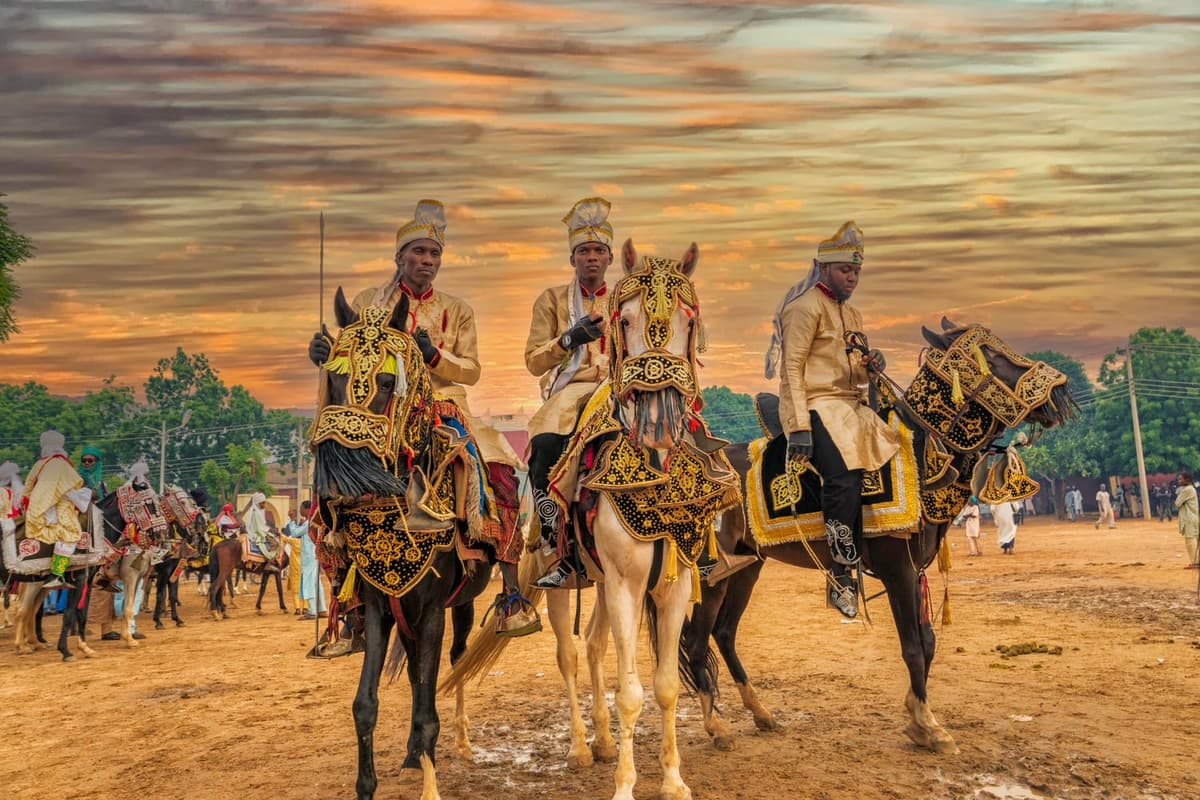
Few spectacles in the Muslim world match the Durbar. On the mornings of Eid, in the old emirate cities of northern Nigeria, hundreds of horsemen in flowing robes and turbans gather behind their Emir, the drums and long kakaki trumpets sound, and a river of colour pours through the streets toward the palace. At the climax, ranks of riders gallop straight at the seated Emir, swords raised, then rein in hard at the last moment to salute him. It is part religious celebration, part royal pageant, part living memory of the old Sahelian cavalry.
For many Pakistani and Muslim readers the timing will feel instantly familiar: the Durbar is woven into Eid al-Fitr and Eid al-Adha, the same two festivals you mark at home. This guide covers what the Durbar is and where it came from, when it happens on the Islamic calendar, what unfolds during the parade, the main cities that hold it, and how a traveller would reach them.
Read the safety section first. Northern Nigeria carries serious, current security warnings, and several of the Durbar's home states sit under the strongest "do not travel" advisories from both the UK and the US. This article is an honest cultural guide, not an invitation to ignore those warnings — please treat the Safety and travel advisories section as the most important part of the page.
Quick facts
| Event | Durbar (Hausa: Hawan Sallah) — Eid horse procession and cavalry salute |
| Where | Emirate cities of northern Nigeria: Kano, Katsina, Zaria, Sokoto, Bida and others |
| When | Tied to Eid al-Fitr (end of Ramadan) and Eid al-Adha (Eid el-Kabir / Sallah) |
| 2026 Eid al-Fitr | Around 20 March 2026 (subject to the moon sighting) |
| 2026 Eid al-Adha | Around 27 May 2026 (subject to the moon sighting) |
| Origins | Emirate cavalry tradition dating back centuries (Kano links it to Emir Rumfa, 15th c.) |
| Largest | The Kano Durbar is often called the world's largest horse parade |
| Main airports | Mallam Aminu Kano International (KAN); Nnamdi Azikiwe International, Abuja (ABV) |
| Cost to watch | The street procession is free; grandstand/tourism packages may be ticketed |
| Safety | High-risk region — see advisories below before any planning |
Eid dates depend on the sighting of the moon and are confirmed only days ahead. Confirm the year's dates and any official Durbar programme through Nigerian tourism authorities, and always check the latest UK FCDO and US State Department advice before booking anything.
What the Durbar is — and where it came from
The Durbar is the great public celebration of the Hausa-Fulani emirates of northern Nigeria. The word "durbar" reached English from the Persian darbar (a ruler's court) via British India, but the event itself is rooted in an older local tradition: the seasonal mustering of an emirate's cavalry before its ruler.
For centuries the city-states of the Sahel — Kano, Katsina and Zaria (Zazzau) among them — depended on mounted warriors. Horses were prized trade goods alongside salt, gold and textiles, and each noble household kept horses and riders ready to defend the emirate. On feast days those regiments paraded before the Emir to display their strength, horsemanship and loyalty. Kano traditionally traces its equestrian pageantry to the reign of Emir Muhammadu Rumfa in the 15th century, and the wider custom is described in encyclopedic overviews such as Wikipedia's article on the Durbar festival.
When the cavalry's military role faded, the parade survived as ceremony. Today the Durbar is purely festive and religious: a way for an emirate to renew the bond between the people and their traditional ruler on the holiest days of the Muslim year. Cultural institutions including Google Arts & Culture document the Kano Durbar as one of West Africa's most striking spectacles.
When it happens — the Islamic-calendar timing
The Durbar is not a fixed-date festival. It is celebrated twice a year, anchored to the two Eids:
- Eid al-Fitr — the festival ending Ramadan. In Hausa this Durbar is part of Hawan Sallah.
- Eid al-Adha — known in Nigeria as Eid el-Kabir or Sallah, the same festival of sacrifice you observe in Pakistan.
Because the Islamic (Hijri) calendar is lunar, both Eids move about 10–11 days earlier each Gregorian year and are confirmed only when the new moon is sighted. For 2026, Eid al-Fitr is expected around 20 March and Eid al-Adha (Eid el-Kabir) around 27 May, per Nigerian calendars such as PublicHolidays.africa's Id el-Kabir listing. Treat these as estimates and confirm closer to the time.
The festivities usually run for several days, not a single morning. In Kano the celebration unfolds in stages over the Eid period — locally named hawan ("the ride") — including Hawan Sallah, Hawan Daushe and Hawan Nassarawa, each with its own route and meaning, building to the grand procession to the Emir's palace.
For Muslim travellers the timing is a genuine draw: you can mark Eid prayers in a historic emirate, then witness the same festival expressed through a completely different cultural lens.
What actually happens
The heart of the Durbar is a mounted procession to the Emir's palace, and the spectacle is in the detail:
- The horses and regalia. Riders wear layered robes, embroidered gowns and turbans; horses are draped in richly decorated caparisons and bells. Title-holders, district heads and household regiments ride together, each group identifiable by its colours.
- Music and sound. Long metal kakaki trumpets, drums and praise-singers accompany the columns — hooves, drumming, ululation and, in some places, gunfire salutes.
- The Emir's entourage. The Emir rides under a ceremonial parasol, surrounded by guards, musicians and dignitaries, in a slow, stately progress that contrasts with the charging horsemen.
- The jahi (cavalry salute). The climax: groups of horsemen gallop toward the seated Emir, swords raised, then pull up sharply just before reaching him to salute and pledge loyalty — a controlled, thrilling display of horsemanship.
In Kano the route traditionally moves between palaces and historic quarters, with stages such as Hawan Nassarawa (a "victory" procession visiting the Nassarawa Palace and ancestral tombs) described in coverage like Premium Times' reporting on Kano's Durbar routes. Programmes change year to year — and have recently been affected by local emirate politics and government restrictions — so the exact route and scale are never guaranteed in advance.
The main cities
Several northern emirates hold a Durbar; these four are the best known:
- Kano — the biggest and most famous. The Kano Durbar is regularly described as the largest horse parade in the world, drawing the most riders and the most onlookers. Kano has the region's main international airport.
- Katsina — a historic Hausa city-state with a strong Durbar tradition and deep cavalry roots.
- Zaria (Zazzau) — one of the original Hausa city-states, with an old walled city and its own emirate pageantry.
- Sokoto — seat of the Sokoto Caliphate's spiritual legacy; its Sallah celebrations carry particular religious weight.
Other towns such as Bida (in Niger State) also hold notable Durbars. Of these, Kano is the one most travellers have historically aimed for because of its scale and air links — but, as the safety section makes clear, every one of these cities currently sits in a high-risk advisory zone.
Safety and travel advisories — read this first
This is the part of the guide that matters most. Northern Nigeria currently carries some of the strongest travel warnings in the world, driven by banditry, kidnapping for ransom, terrorism, inter-communal violence and general insecurity. The Durbar's home states are squarely inside the warned areas. Do not let the beauty of the festival lead you to underestimate this.
As of mid-2026:
- UK FCDO advises against all travel to Katsina state, and against all but essential travel to Kano, Kaduna (which includes Zaria) and Sokoto states, among others, citing kidnapping, banditry and violent attacks. See the live page: gov.uk/foreign-travel-advice/nigeria.
- US State Department rates Nigeria overall at Level 3 — Reconsider Travel, and designates Kano, Katsina, Sokoto and Kaduna (along with many other states) at Level 4 — Do Not Travel, citing crime, terrorism, unrest and kidnapping. See: travel.state.gov Nigeria advisory. In April 2026 the US authorised the departure of non-emergency embassy staff from Abuja due to the deteriorating security situation.
What this means in practice:
- Advisories change — always check the latest. Both pages above are updated regularly. The situation can shift in either direction, so check the current wording yourself before any planning, and re-check shortly before travel.
- Travel insurance may be void. If you travel against your government's advice, standard travel insurance is very likely to be invalidated, leaving you exposed on medical, evacuation and cancellation costs. Read your policy's exclusions carefully.
- Never go independently. If travel is taking place at all, it should be through an established operator with serious local security arrangements, vetted ground transport and a clear understanding of which areas and roads to avoid. Road travel between cities is a particular risk.
- Consider experiencing it differently. Given the risks, many people are best served by following the Durbar through documentaries, photo essays and reputable news coverage rather than attending in person. There is no shame in admiring a tradition from a safe distance.
We are presenting this honestly: at the time of writing, mainstream advice from major governments is that much of northern Nigeria should not be visited, or only for essential travel. Respect that.
Etiquette and respect
The Durbar is a religious and royal occasion, not a staged tourist show. If you ever do attend — responsibly, with a trusted local guide, and only if advisories allow — basic respect matters:
- Dress modestly. This is a conservative, predominantly Muslim region. Cover shoulders and legs; women should consider a headscarf. Err well on the conservative side.
- Ask before photographing people. Always seek permission before photographing individuals, especially women and dignitaries. Never photograph the Emir or officials without clear consent, and be wary of pointing cameras at security forces.
- Go with a local guide. A knowledgeable local guide is essential — for safety, for navigating crowds, for understanding what you are seeing, and for knowing the customs around the Emir's procession.
- Mind the crowds and the horses. These are large, fast-moving, densely packed events. Keep clear of charging horsemen, stay where your guide places you, and watch your belongings.
- Observe Ramadan and Eid customs. If you arrive during Ramadan, avoid eating, drinking or smoking in public during daylight hours.
Getting there (in principle)
Practical routing, framed for travellers from Pakistan and the wider region — conditional on the advisories above:
- Flights. There are no direct flights from Pakistan to Kano. The usual approach is to fly from Karachi, Lahore or Islamabad via a Gulf or East African hub — carriers such as Qatar Airways, Etihad, Emirates or Ethiopian Airlines connect to Mallam Aminu Kano International (KAN) or to Nnamdi Azikiwe International, Abuja (ABV), from where domestic carriers (Air Peace, United Nigeria and others) operate short hops to Kano. Compare routes and fares on /air/search.
- Visa. Pakistani passport holders require a visa for Nigeria. Nigeria offers an online e-visa option alongside its High Commission in Islamabad; you'll typically need a passport valid at least six months beyond your stay, and tourist stays are usually short (around 30 days). Sort your paperwork well ahead and see our visa services for help getting started.
- Internal travel. Domestic flights are preferable to long road journeys in the north, where road travel carries elevated kidnapping and banditry risk. This is one more reason an experienced operator should handle any in-country logistics.
If you are weaving Nigeria into a longer trip, our trip planner can help you map flights and timing around the (movable) Eid dates.
Costs and booking notes
- Watching the Durbar is free. The street procession costs nothing to see; you simply need to be in the right city on the right day. Some tourism initiatives offer grandstand seating or guided packages that may be ticketed.
- The real spend is getting there and staying safe. Budget for international and domestic flights, a reputable guide/operator, secure accommodation and transport. Long-haul return fares from Pakistan to Nigeria commonly land in a broad PKR 350,000–700,000+ range depending on season, routing and how far ahead you book — confirm live prices on /air/search rather than relying on any fixed figure.
- Book around an estimate, confirm late. Because Eid dates aren't fixed until the moon sighting, build flexibility into any plan and avoid non-refundable bookings tied to a single rigid date.
If you're drawn to festivals like this
If a vivid cultural festival is what excites you, but you'd rather choose a destination without a "do not travel" overlay, you might enjoy reading about Mexico's huge spring fair in our guide to the Feria Nacional de San Marcos, or — for a different kind of cultural travel — our roundup of the best museums in the world. Both scratch the same itch for colour, crowds and tradition in places that are generally far more straightforward to visit.
FAQ
When is the Durbar Festival held?
The Durbar is tied to the two Eids, so it has no fixed Gregorian date. It is celebrated around Eid al-Fitr (end of Ramadan) and again around Eid al-Adha (called Eid el-Kabir or Sallah in Nigeria). For 2026, Eid al-Fitr falls around 20 March and Eid al-Adha around 27 May, both subject to the moon sighting. Celebrations typically run over several days.
Where is the best place to see the Durbar?
Kano holds the largest and most famous Durbar — often described as the world's biggest horse parade — and has the region's main international airport. Katsina, Zaria and Sokoto also hold notable Durbars. Note, however, that all of these states currently sit under high-risk travel advisories.
Is it safe to travel to northern Nigeria for the Durbar?
Currently, no — not in the ordinary sense. As of mid-2026 the UK FCDO advises against all travel to Katsina and against all but essential travel to Kano, Kaduna (Zaria) and Sokoto, and the US rates Kano, Katsina, Sokoto and Kaduna at Level 4 "Do Not Travel." Always check the FCDO and US State Department pages for the latest position before making any plans. Travelling against advice can also invalidate your insurance.
Do Pakistani citizens need a visa for Nigeria?
Yes. Pakistani passport holders need a visa, available via Nigeria's e-visa system or its High Commission in Islamabad. You'll generally need a passport valid for at least six months beyond your stay. See /visa to get started, and apply well in advance.
What is the cavalry salute at the Durbar?
It's the jahi — the dramatic climax in which groups of horsemen charge at full gallop toward the seated Emir with swords raised, then rein in sharply just before reaching him to salute and pledge loyalty. It is a controlled display of horsemanship descended from the emirates' old cavalry traditions.
What should I wear and how should I behave if I attend?
Dress modestly and conservatively (cover shoulders and legs; a headscarf is advisable for women), always ask permission before photographing people, never photograph the Emir, officials or security forces without consent, and go with a trusted local guide. The Durbar is a religious and royal occasion, so respectful behaviour is essential.
A respectful conclusion
The Durbar is one of the great living pageants of the Muslim world — a centuries-old expression of faith, horsemanship and emirate identity, staged on the very days of Eid you already hold dear. It deserves to be admired, and understood, on its own terms.
But admiration has to be paired with honesty. Right now, the cities that host the Durbar sit in a region under grave security warnings, and the responsible advice from the UK and US is that most of northern Nigeria should not be visited. The respectful thing — and the safe thing — is to keep yourself fully informed, check the FCDO and State Department advisories every time, and to recognise that sometimes the wisest way to honour a tradition is to celebrate it from afar until conditions allow safe travel.
Written by
Travel.pk Editorial Desk
Researches and edits practical travel guidance for people planning journeys from Pakistan.
How we research and edit →Comments
Loading comments…