Publication and freshness
This article predates our verified-timestamp system; its original publication date was not reliably recorded, so no publication or freshness date is claimed.
Byline record
Editorial Desk byline. No personal contributor profile is claimed.
Sources and method
Inspect the primary-source links in the article and our research method. Changing rules must be rechecked at the official source.
Separate review record
No separately stored fact-checker or fact-check date is published for this article. Edit history: no recorded revisions since revision tracking began.
A complete guide to Bodh Gaya, where the Buddha attained enlightenment: the Bodhi Tree, the Mahabodhi Temple, the best time to visit, how to get there and visa notes.
Some places are sacred because of what was built there. Bodh Gaya is sacred because of what happened there. Roughly 2,500 years ago, an Indian prince called Siddhartha Gautama sat beneath a fig tree on the bank of the Niranjana River, resolved not to rise until he understood the nature of suffering — and, the tradition says, became the Buddha, "the awakened one." The descendant of that tree still grows on the same spot, in a small town in the Indian state of Bihar, and pilgrims have been coming to sit beneath it for more than two millennia.
The result is one of the most atmospheric religious sites in Asia: the soaring Mahabodhi Temple, the living Bodhi Tree draped in prayer flags, and a town ringed by monasteries built by Buddhist nations from Thailand to Bhutan to Japan. It is the holiest of the four great pilgrimage sites of Buddhism, and a UNESCO World Heritage Site since 2002.
This guide covers what Bodh Gaya is and why it matters, what to see, when to go, how to reach it, and the etiquette that keeps it a place of practice rather than just sightseeing. A frank note up front for Pakistani readers: India is currently very hard to visit on a Pakistani passport, so read the visa section before you plan anything — but the easier-to-reach Nepali end of the Buddhist circuit, Lumbini, is covered too.
Quick facts
| Where | Bodh Gaya, Gaya district, Bihar, eastern India |
| What | Site of the Buddha's enlightenment; the Mahabodhi Temple Complex and Bodhi Tree |
| Status | UNESCO World Heritage Site (inscribed 2002) |
| Main temple | Mahabodhi Temple, a brick tower roughly 55 m (180 ft) tall, Gupta-era core (5th–6th century CE) |
| Entry | Temple complex entry is free; nominal camera/video fees apply (verify on arrival) |
| Best time | October to February (cool, dry); festivals peak around Buddha Purnima (May) |
| Nearest airport | Gaya International Airport (~12–15 km); Patna is the larger hub (~110 km) |
| Pakistani visa | Severely restricted for India — see the visa note below |
Why Bodh Gaya matters
Buddhism recognises four principal pilgrimage sites tied to the life of the Buddha: Lumbini (his birth, in present-day Nepal), Bodh Gaya (his enlightenment), Sarnath (his first teaching), and Kushinagar (his death and final release) (Tricycle: the four sacred sites). Of these, Bodh Gaya is the spiritual centre of gravity — the moment of awakening from which everything else in the tradition flows.
The town grew around that single event. After his enlightenment, the texts say, the Buddha spent seven further weeks meditating at seven nearby spots — each now marked within or beside the temple complex, including the Animeshlochana Stupa (where he gazed unblinking at the tree in gratitude), the jewelled-walk Chankramana, and the lotus pond (UNESCO World Heritage: Mahabodhi Temple Complex). Walk the grounds and you are tracing the geography of those weeks.
The Bodhi Tree, the Vajrasana and Ashoka
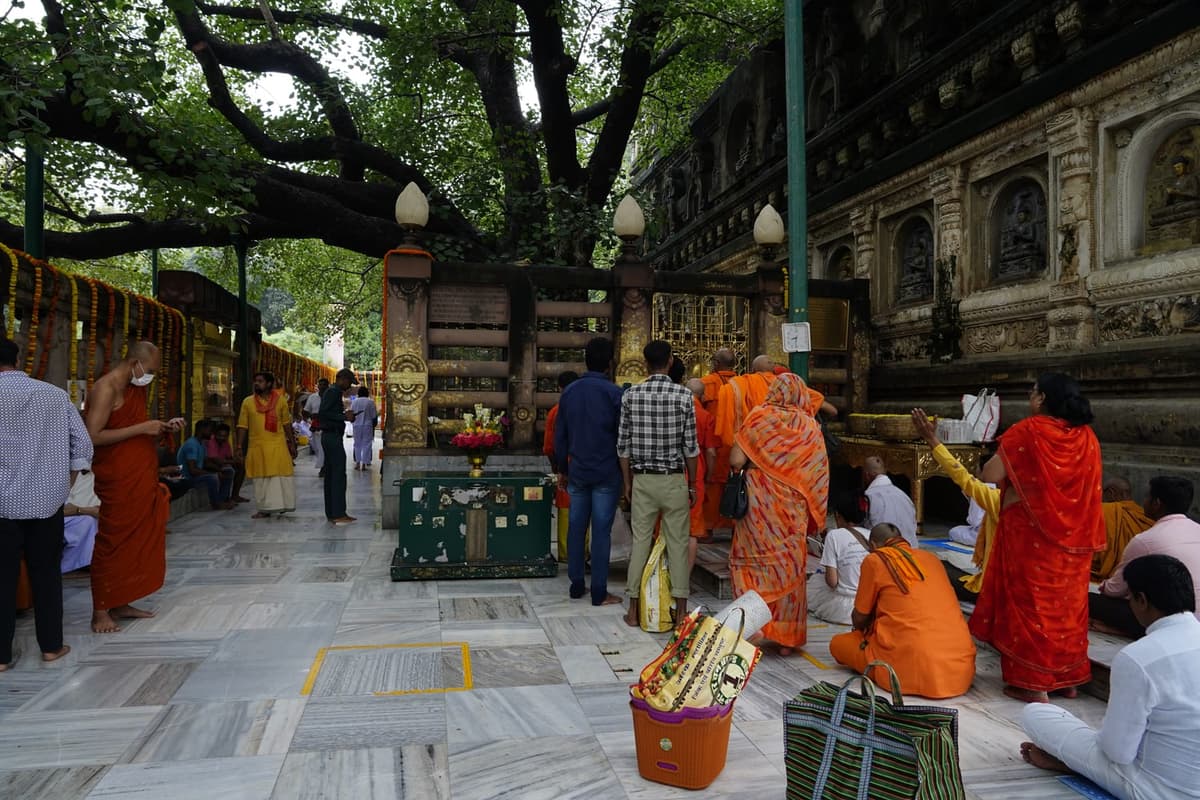
Three things anchor the site. The Bodhi Tree itself — a sacred fig (Ficus religiosa) — is held to be a direct descendant of the tree the Buddha sat under; cuttings of the lineage were carried across Asia, most famously to Anuradhapura in Sri Lanka by Ashoka's daughter Sanghamitta, and saplings have been brought back over the centuries to replace trees lost to storms and age.
Beneath it sits the Vajrasana, the "diamond throne" — a polished sandstone slab marking the exact spot of enlightenment. It is attributed to the Emperor Ashoka, who visited around the mid-3rd century BCE, roughly 250–233 BCE, and built the first shrine here, formalising Bodh Gaya as a place of pilgrimage (UNESCO World Heritage: Mahabodhi Temple Complex).
The great brick Mahabodhi Temple you see today — a tapering tower around 55 metres high, surrounded by smaller votive stupas — has a Gupta-period core from the 5th–6th century CE, much restored over the centuries (Wikipedia: Mahabodhi Temple). Inside sits a gilded image of the Buddha touching the earth — the bhumisparsha gesture, calling the earth to witness his awakening.
Best time to visit
The comfortable season is firmly October to February, when Bihar's fierce heat has eased and daytime temperatures sit roughly in the 8–25°C band — sunny days, cool nights, ideal for walking the complex and the ring of monasteries (Holidify: best time to visit Bodh Gaya). This is also when the winter influx of Tibetan and international pilgrims gives the town its most vivid atmosphere.
Avoid April to June, when the plains bake well into the 40s°C, and the July–September monsoon, which brings heavy rain and humidity.
Two festival windows are worth knowing:
- Buddha Purnima (Vesak) — usually in May, marking the Buddha's birth, enlightenment and death. Bodh Gaya fills with devotees, processions and chanting; it is the single most important day of the year here, though also hot.
- The Kalachakra — a major Tibetan Buddhist initiation occasionally led by the Dalai Lama in the winter months. It draws tens of thousands of monks and pilgrims when held, transforming the town. Dates are irregular and announced in advance, so check before building a trip around it.
How to get there
Bodh Gaya sits about 12–15 km from the city of Gaya, which has both the nearest airport and the nearest major railhead.
- By air: Gaya International Airport (GAY) is the closest, roughly 12–15 km away (about 20–30 minutes by taxi). It has seasonal and domestic links — Air India, IndiGo and others — plus international charter flights for Buddhist pilgrims from Southeast Asia in season. Schedules thin out outside peak pilgrimage months, so check current routes (TravelSetu: how to reach Bodh Gaya).
- By train: Gaya Junction is a major stop on India's eastern network, with frequent trains from Patna, Varanasi, Kolkata and Delhi. From the station it's a short 12–15 km taxi or auto-rickshaw ride to Bodh Gaya.
- From Patna: Bihar's capital and largest airport (Jay Prakash Narayan International) is about 110 km away — roughly a 2.5–3 hour drive, or a short hop by train to Gaya.
- From Varanasi: a natural pairing with Sarnath, Varanasi is a few hours away by train to Gaya, making the two easy to combine.
For Pakistani travellers, the practical reality is that there are no direct flights between Pakistan and India, so any routing would go via a third country (typically the Gulf) into Delhi, Kolkata or Patna — assuming a visa is in hand. Compare fares and connections on flight search once your travel status is confirmed.
What to see and do
The Mahabodhi Temple Complex
The heart of any visit. Enter, deposit your shoes, and move clockwise. You'll pass the main temple, the Bodhi Tree behind it (with the Vajrasana at its base, usually fenced and draped in offerings), the seven sacred spots of the post-enlightenment weeks, the lotus pond with its statue of the Buddha sheltered by the serpent-king Muchalinda, and rows of small stupas left by pilgrims over centuries. Early morning and dusk, when monks chant and butter lamps are lit, are the most moving times to be there.
The international monasteries
Bodh Gaya's second great pleasure is its ring of monasteries and temples, each built in the architectural style of a different Buddhist nation — effectively a free open-air tour of Buddhist Asia:
- The Thai Monastery (Wat Thai), with its gleaming golden, curved roof.
- The Tibetan (Karma) temples and Namgyal Monastery, hung with prayer flags and prayer wheels.
- The Japanese Indosan Nipponji Temple, serene and minimalist.
- The Royal Bhutan Monastery, with finely detailed murals.
- Monasteries and rest-houses built by Myanmar, Sri Lanka, Vietnam, China, Nepal and others.
The Great Buddha Statue
A short walk away stands the 80-foot (about 25 m) Great Buddha Statue, dedicated in 1989 — seated in meditation, ringed by stone disciples, and one of the most photographed sights in town.
Sujata Stupa and the river
Across the (usually dry) Niranjana River lies Sujata Garh / Sujata Stupa, marking the village of the woman who, the story goes, offered the starving ascetic a bowl of milk-rice, prompting him to abandon extreme self-mortification for the "middle way." It's a peaceful, less-visited counterpoint to the busy temple.
Costs and booking notes
Entry to the Mahabodhi Temple Complex is free. There is a nominal camera/photography fee — widely reported at around ₹100 for a still camera and ₹300 for video — and mobile-phone use inside the inner sanctum is often restricted, with shoes and sometimes bags deposited at counters. These charges and rules change, so verify on arrival rather than treating any figure as fixed (TravelSetu: Mahabodhi Temple guide).
Accommodation spans a wide range: many foreign monasteries run simple, inexpensive guest-houses for pilgrims, alongside mid-range hotels and a few upscale properties. Budget pilgrim rooms can run from very modest rates up to international-standard hotels at much higher prices; book ahead for Buddha Purnima and any Kalachakra dates, when the town fills completely.
For a multi-site Buddhist trip, our trip planner can help sequence flights, trains and stops, and it's worth pricing a guided holiday package, since logistics in Bihar and eastern Uttar Pradesh reward local knowledge.
Safety, etiquette and practical tips
Bodh Gaya is a working pilgrimage site, not a museum, and visitors of every faith are welcome — but the etiquette matters:
- Dress modestly. Cover shoulders and knees; remove shoes and hats before entering the temple and monastery shrines.
- Move clockwise around the temple and the Bodhi Tree, in keeping with the practice of circumambulation (pradakshina).
- Keep quiet and low-key. People are meditating and prostrating all around you. Silence your phone, don't photograph people praying without consent, and never climb on stupas or the throne enclosure.
- Don't take Bodhi leaves. Fallen leaves are sacred to pilgrims; collecting or pulling them is frowned upon (and you may be asked not to).
- Health and water. Carry bottled water, mind street food if you have a sensitive stomach, and consider standard travel-health precautions for rural Bihar.
- Touts and taxis. Agree fares before getting into an auto-rickshaw, and book trains and airport transfers in advance where you can.
Whatever your route in, sensible travel insurance is worth having for a trip that mixes air, rail and rural road travel.
Visa notes for Pakistani travellers
This is the part to read first. India is currently extremely difficult for Pakistani passport-holders. There is no ordinary tourist visa or e-Visa for Pakistani nationals; applications go through a restricted "visit visa" process that is subject to 100% prior reference to India's Ministry of Home Affairs, can take roughly two months or more, and is granted only for limited purposes (Consulate General of India, Dubai: visit visa for Pakistani nationals). Bilateral tensions have at times led to visas being suspended outright. In short: assume India is, for now, largely off the table for Pakistani leisure travellers, and check the latest position before spending money. Our visa services team can advise on current eligibility.
The good news for the wider Buddhist circuit: Nepal is straightforward. Pakistani citizens are eligible for a free 30-day tourist visa on arrival once per calendar year, issued at Tribhuvan International Airport in Kathmandu and designated land borders (Embassy of Nepal, Islamabad: visa). That puts Lumbini, the Buddha's birthplace, well within reach even when India is not — a meaningful consolation for pilgrims and history-lovers alike.
A short Buddhist-circuit itinerary
If you can travel the full route, the classic pilgrimage links the four great sites. A workable framing:
- Bodh Gaya (Bihar) — the enlightenment. Base here 2–3 days for the Mahabodhi complex, the monasteries and Sujata Stupa.
- Sarnath (near Varanasi, Uttar Pradesh) — where the Buddha gave his first teaching. The Dhamek Stupa and the excellent archaeological museum are the highlights; easily combined with Varanasi itself.
- Kushinagar (Uttar Pradesh) — where the Buddha died, marked by the great reclining-Buddha statue in the Mahaparinirvana Temple.
- Lumbini (Nepal) — the birthplace, centred on the Maya Devi Temple and the Ashokan pillar. The most accessible of the four for Pakistani travellers, thanks to Nepal's visa-on-arrival.
Done in sequence, the circuit traces the whole arc of the Buddha's life — birth, awakening, first teaching, and passing — across roughly a week to ten days, with internal flights and trains stitching the legs together.
If you're drawn to layered, living heritage like this, our guide to the best time to visit Karnataka covers another corner of India where temples, climate and timing all shape the trip.
FAQ
Is Bodh Gaya open to non-Buddhists and tourists?
Yes. The Mahabodhi Temple Complex welcomes visitors of all faiths and none. You're asked to respect the site's purpose — dress modestly, stay quiet, move clockwise and avoid disturbing those at prayer — but you don't have to be Buddhist to visit.
How much does it cost to enter the Mahabodhi Temple?
Entry to the temple complex is free. There is only a small camera/photography fee (commonly cited at around ₹100 for stills and ₹300 for video), and phones may be restricted in the inner sanctum. Fees and rules change, so confirm at the entrance.
What is the best time of year to visit?
October to February, when the weather is cool and dry. Buddha Purnima (around May) is the most important festival but falls in the hot season; the occasional Kalachakra teaching in winter is a major draw when it's held.
How do I get to Bodh Gaya?
Fly into Gaya International Airport (about 12–15 km away) or the larger Patna airport (~110 km), or take a train to Gaya Junction from Patna, Varanasi, Kolkata or Delhi, then a short taxi to Bodh Gaya.
Can Pakistani citizens visit Bodh Gaya?
It's currently very difficult. India does not offer normal tourist or e-Visas to Pakistani nationals; the restricted visit-visa process is slow, purpose-limited and subject to Indian Home Ministry clearance, and has at times been suspended. Check the latest status before planning. Nepal's Lumbini, by contrast, is reachable on a visa on arrival.
Is the Bodhi Tree the original tree?
No, but it is held to be a direct descendant of it. The lineage has been propagated and replanted over more than two thousand years, including via cuttings taken to Sri Lanka in Ashoka's time and brought back to replace lost trees.
Conclusion
Bodh Gaya rewards stillness more than sightseeing. The temple is magnificent and the international monasteries are a delight to wander, but the lasting memory most visitors carry away is quieter — sitting in the shade of a fig tree that links them, through an unbroken chain of saplings and pilgrims, to a moment of insight 2,500 years old.
If India remains out of reach for now, hold the idea lightly and keep Lumbini in mind — and when the time is right, our trip planner and visa services can help you turn the pilgrimage from an aspiration into an itinerary.
Written by
Travel.pk Editorial Desk
Researches and edits practical travel guidance for people planning journeys from Pakistan.
How we research and edit →Comments
Loading comments…